Take the Free Big Five Personality Test
You know yourself better than anyone. You also carry blind spots no one has ever named out loud — strengths you waste, and soft spots the wrong people learn to lean on. In about seven minutes, this test names both.
Talents you’ve stopped noticing. The things that come so easily you assume everyone can do them — named at last, so you use them on purpose instead of by accident.
The weak points other people can press. Where you overspend trust, fold under one kind of pressure, or hand someone an easy lever. Far better you find it before they do.
The you that other people actually meet. The gap between who you are on the inside and how you land in a room — and what to do about it.
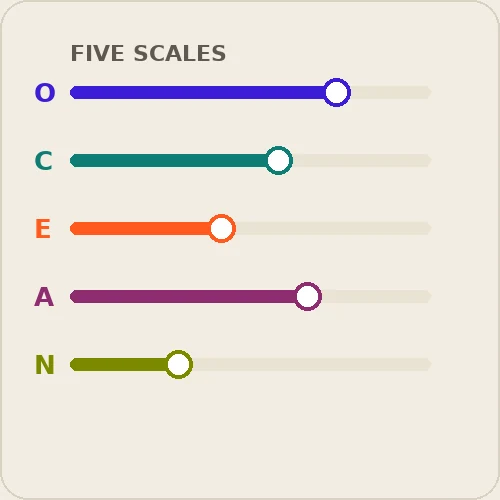
Not a box. A position on five honest scales.
You land somewhere on every one of them at once. That is what makes the read feel like you, and not like one of sixteen types.
A real read, not a one-line label.
Most quizzes give you a sticker and a paragraph. Here is what lands on your screen at the end.
A clear score on all five traits
Where you actually sit on each scale, with a gauge you can read at a glance.
Your ownable identity on each
The Explorer, the Architect, the Deep Feeler. The version of you that scale describes.
Where you shine, and one honest blind spot
Strengths first, then the single trade-off that makes the praise believable.
What it means for love and work
How the trait actually plays out with the people and the jobs in your life.
A growth edge you can use this week
One concrete, doable move per trait. Not advice, a next step.
Your rare two-trait type
The combination that is most uniquely you, named and explained.
Five independent scales. Effectively no one gets your exact result.
Why you can trust this Big Five test.
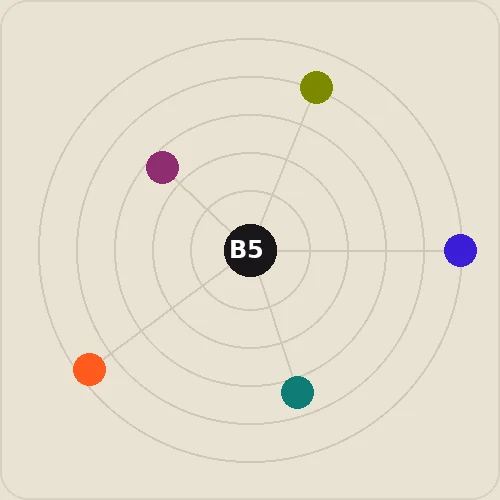
The Big Five was discovered, not invented. Working independently for decades, researchers kept finding the same five dimensions in how people describe each other. That data-first origin is why it outperforms designed typologies.
This is not a horoscope and not a clinical test. It is an honest mirror: real tendencies, framed plainly, with a way to grow.
A public-domain instrument
The IPIP Big-Five markers (Goldberg), validated against the gold-standard NEO-PI-R.
It measures what MBTI ignores
A whole dimension of emotional sensitivity that four-letter types leave out entirely.
Honest about the science
Real tendencies, not destiny. Personality effects are modest, and you can grow on every scale.
What is the Big Five personality test?
The Big Five is the personality framework most psychologists actually use. It is also called the Five-Factor Model, or OCEAN, after the five traits it measures: Openness, Conscientiousness, Extraversion, Agreeableness, and Neuroticism.

Unlike type quizzes that drop you into one of a handful of boxes, the Big Five scores you on five separate scales at once. Each trait runs on a continuum, so two people who are both "high in Extraversion" can still be very different everywhere else. That is why a Big Five result reads like a profile of you, not a horoscope.
This free Big Five personality test uses the public-domain IPIP markers (more on that below). It takes about seven minutes, runs entirely in your browser, and gives you a full read on all five traits plus your two-trait type at the end.
The five OCEAN traits, in plain language
Each trait breaks down into narrower facets, which is what lets a good report say something specific instead of generic.
Openness to experience
Curiosity, imagination, and appetite for ideas, art, and the new. High scorers chase novelty and abstraction; lower scorers trust the proven and concrete. Facets include imagination, aesthetics, and intellect.
Conscientiousness
Organization, discipline, and follow-through. It splits into orderliness (a tidy desk) and achievement-striving (relentless drive), which do not always travel together.
Extraversion
Where you draw your energy. It is not just loud versus shy: assertiveness and gregariousness are different facets, which is exactly why quiet, decisive leaders exist.
Agreeableness
Warmth, trust, and cooperation. High scorers prioritize harmony; lower scorers are blunt and hard to manipulate. Compassion and politeness are distinct sides of it.
Neuroticism
Sensitivity to stress and negative emotion, best read as a sensitivity dial rather than a flaw. Worry and irritability are separate facets, so the same score can feel very different from one person to the next.
Is the Big Five test accurate? The science behind it
The Big Five was discovered, not invented. Starting in the 1960s, researchers analyzed the thousands of words people use to describe one another (an approach called the lexical hypothesis) and kept landing on the same five dimensions, independently and across decades (Tupes & Christal, 1961; Norman, 1963; Goldberg, 1990). The structure then replicated across cultures and languages, which is the kind of evidence a designed quiz can never show.
The questions here are the IPIP Big-Five markers (Goldberg, 1992), a public-domain instrument validated against the field's reference standard, the NEO-PI-R (Costa & McCrae, 1992). That is also why we can offer the test for free, with no licensing strings attached.
It is worth being honest about the limits. This is a self-report measure, results shift a little with time and mood, and personality effects on life outcomes are real but modest (correlations around r = 0.2). Treat your scores as well-evidenced tendencies, not a verdict, and as a tool for self-reflection rather than a clinical diagnosis.
Big Five vs. Myers-Briggs (MBTI)
If you already know your MBTI letters, here is how they line up. Researchers have mapped the two systems directly (McCrae & Costa, 1989): MBTI's Extraversion-Introversion tracks Big Five Extraversion (the strongest overlap), Sensing-Intuition tracks Openness, Thinking-Feeling tracks Agreeableness, and Judging-Perceiving tracks Conscientiousness.
The core difference is shape. MBTI sorts you into one of sixteen fixed types, while the Big Five measures each trait on a scale. Because most people score near the middle, a type system has to round you up or down, which is part of why an MBTI result can flip between sittings. On test-retest reliability and prediction of real outcomes, the trait approach has the stronger track record in peer-reviewed research.
One more gap worth knowing: MBTI has no equivalent for Neuroticism, the trait most closely tied to well-being. Our test measures it. And to keep the best part of typologies, we still hand you an ownable label and a two-trait type alongside your scores.
What your Big Five scores can predict
Personality is not destiny, but decades of research show the Big Five lines up with outcomes that matter. A few of the most replicated findings:
Work. Conscientiousness is the single strongest personality predictor of job performance across almost every occupation, established in a classic meta-analysis of 117 studies (Barrick & Mount, 1991). Emotional stability (lower Neuroticism) is the second most consistent.
Health and longevity. Conscientious people tend to live longer, largely through steadier habits and better follow-through on health decisions (Friedman & Martin, The Longevity Project, 2011).
Relationships. Higher Agreeableness and lower Neuroticism are the most reliable trait predictors of relationship satisfaction (Malouff et al., 2010).
Looking across the whole field, traits predict consequential life outcomes about as well as intelligence or social class do (Ozer & Benet-Martínez, 2006; Roberts et al., 2007). These are group-level tendencies with modest effect sizes, not promises about any one person.
How we score your results
You answer 50 statements on a five-point scale from disagree to agree, ten for each trait. Reverse-worded items are recoded so a higher score always means more of the trait, then each trait is converted to a 0 to 100 score and placed in one of three bands: Lower (below 40), Balanced (40 to 60), or Higher (above 60).
All of that math happens on your device. Your answers are never stored on a server or sent anywhere, and there is no account to create. Close the tab and nothing remains.
Frequently asked questions
Should I think hard about each statement, or go with my gut?
Go with your gut. The first reaction is usually the honest one, and the scoring is built to absorb a stray answer or two without tipping the result. If a statement makes you stop and weigh exceptions, that hesitation is a sign you are overruling your instinct. Answer for how you tend to be on an ordinary day, not for your best day or your worst.
Is it better to score high or low on a trait?
Neither. Every scale has two useful ends and a cost at each extreme. A high scorer on Conscientiousness gets things done but can tip into rigidity; a low scorer stays loose and adaptable but can let deadlines slide. The result describes you, it does not grade you. Read each trait for what it gives you and what it asks of you, and ignore any instinct to chase a "good" number.
What does it mean if I land in the middle on most traits?
It means you are flexible where many people are fixed. Mid-range scores are common and they are not a failure of the test to "read" you. On Extraversion, for instance, a middle score is the ambivert who can lead a room or work alone and switches comfortably between the two. The practical upside is range. The thing to watch is drift, since a middle score gives you fewer strong defaults to fall back on.
I took it again and got a slightly different result. Why?
Small shifts are normal and expected. Your mood, how recently you slept, and even how you read a particular sentence all nudge the numbers a little. What stays steady is your position relative to other people: someone high in Openness today is very unlikely to read as low next month. If a single trait moved by a few points, that is noise. If it moved by twenty, something real probably changed, or you answered the first time in a hurry.
Can my personality actually change over the years?
Yes, slowly and in fairly predictable directions. Across adulthood most people gain in Conscientiousness and Agreeableness and ease off in Neuroticism, a long, gentle drift that researchers call the maturity principle. Big life events and deliberate effort can move a trait too. None of this happens overnight, and your rank against your peers tends to hold even as the whole group matures together. Treat your result as a snapshot, not a sentence.
Why don't I get a four-letter type at the end?
Because a code like that throws away most of what the test measured. The Big Five scores you on five sliders, not four switches, and collapsing a slider into a letter loses the difference between someone who is barely Extraverted and someone who is wildly so. You do get a short, named type here, drawn from your two strongest signals, but it sits on top of the full five-trait read rather than replacing it. The detail is the point.
What should I actually do with my results?
Start with the one trait that surprised you, since that is where the read has something to teach. Each section ends with a growth edge written as a single concrete move rather than a vague aspiration. Pick one and try it for a week. Sharing your profile with someone who knows you well is also worth doing; their reaction tells you whether the description landed, and the conversation is often more useful than the scores on their own.
Sources and further reading
The peer-reviewed science this test and its interpretations are built on.
- Tupes, E. C., & Christal, R. E. (1961/1992). Recurrent personality factors based on trait ratings. Journal of Personality.
- Norman, W. T. (1963). Toward an adequate taxonomy of personality attributes. Journal of Abnormal and Social Psychology.
- Goldberg, L. R. (1992). The development of markers for the Big-Five factor structure. Psychological Assessment. See also the IPIP project.
- Costa, P. T., & McCrae, R. R. (1992). Revised NEO Personality Inventory (NEO-PI-R). Psychological Assessment Resources.
- Barrick, M. R., & Mount, M. K. (1991). The Big Five personality dimensions and job performance: a meta-analysis. Personnel Psychology.
- Ozer, D. J., & Benet-Martinez, V. (2006). Personality and the prediction of consequential outcomes. Annual Review of Psychology.
- Malouff, J. M., et al. (2010). The five-factor model of personality and relationship satisfaction: a meta-analysis. Journal of Research in Personality.
- Roberts, B. W., et al. (2007). The power of personality. Perspectives on Psychological Science.
- Friedman, H. S., & Martin, L. R. (2011). The Longevity Project. Hudson Street Press.
- McCrae, R. R., & Costa, P. T. (1989). Reinterpreting the Myers-Briggs Type Indicator from the perspective of the five-factor model. Journal of Personality.
Content reviewed against the published IPIP and NEO-PI-R literature. Last reviewed: May 2026.
Ready to meet yourself?
Free. No sign-up. Scored privately on your device.